A page per service area
Written with real local detail, never a copy-pasted paragraph.
A roofing service area page ranks when it says something specific about that town and the services you provide there, rather than swapping a single word into an otherwise identical paragraph across every location.
What it costs
Search engines can detect when a set of "location pages" are the same paragraph with a town name swapped in, and they treat that as duplicate content rather than distinct, useful pages. We write real detail for each town: which services you actually offer there, and any local specifics worth including, such as common roof styles or storm patterns for that area.
A page for every town or county you genuinely serve, crossed with your core services, is what gives an independent roofing company enough real estate to compete against national directory sites with thousands of thin listings. Coverage claimed but not built as a page rarely ranks.
Adding a new town, or retiring one you no longer serve, is handled as a standard revision, so the page matrix stays accurate as your business grows rather than drifting out of date.
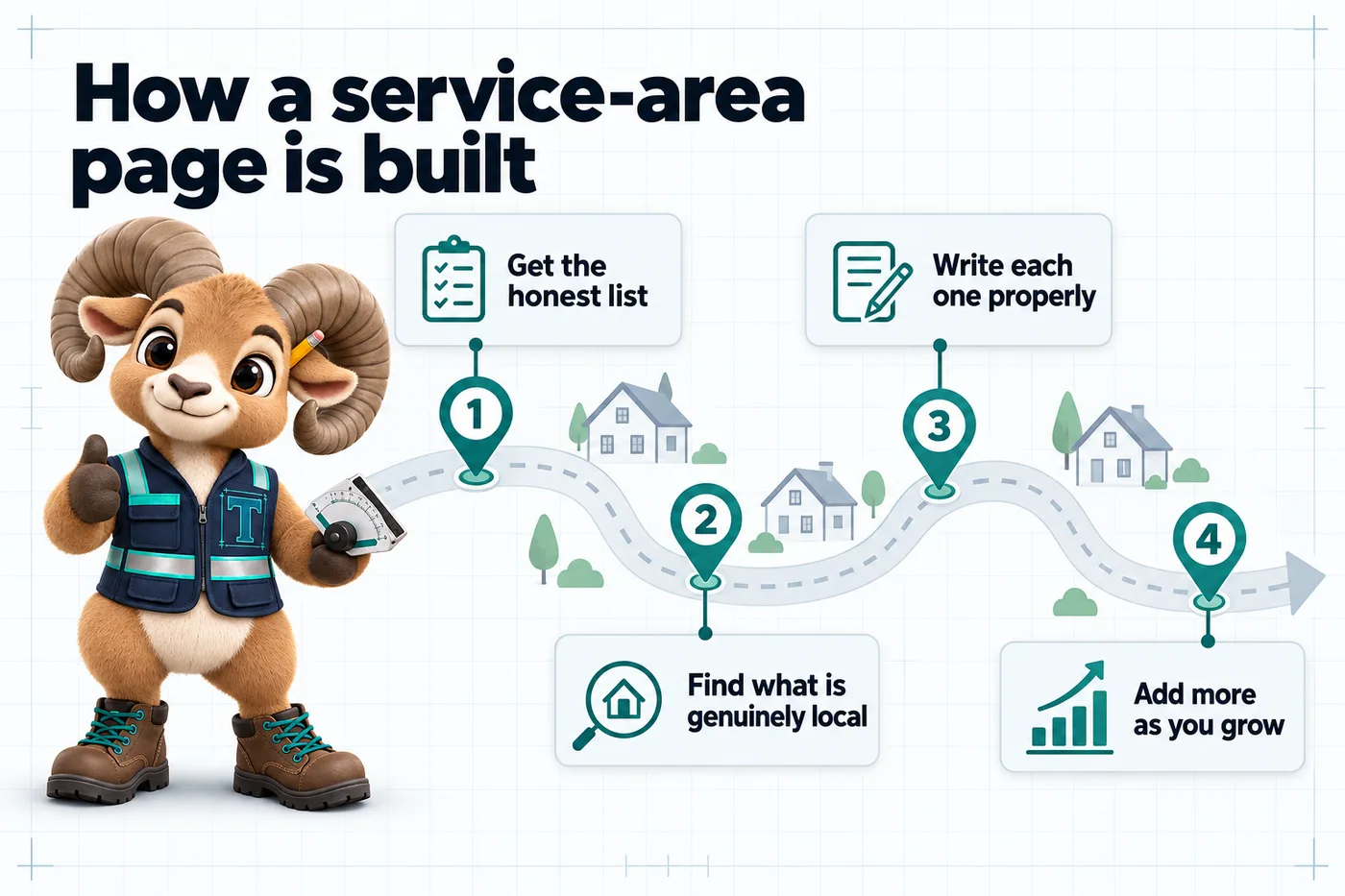
Not the aspirational map. The towns you actually send a crew to, in order of how much work comes from each.
We ask you what is different about roofing there: the age of the housing, the permit process, the common failure, the storm that everyone remembers. That is the part a template cannot fake.
The services you sell there, the local detail, the proof from that area, the route to the quote tool. Structured the same way each time so a search engine can compare them fairly against directories that carry no content at all.
A new town is one revision. Send us the place and anything specific about it, and the page is live within the standard turnaround.
How long it takes
The initial set is built before launch. New towns after launch are one revision each, live within 2 to 5 working days.
None of these change the plan price. They change how much work sits inside it, which is why the fee is a plan rather than an hourly rate. See the plans.
If more than two of these describe your situation, this page is about you.
The second list matters more than the first. A scope with no exclusions is a scope nobody has thought about.
Included
Not included
If you need one of these, say so on the demo. We would rather point you somewhere else than take the work and disappoint you.
Written with real local detail, never a copy-pasted paragraph.
Each area page reflects the services you actually offer there.
New or retired service areas updated as a standard revision.
Nearby service area pages link to each other for both readers and search engines.
Nothing on this page is an add-on or an upsell. The three plans differ in launch time, article volume and whether the AI Engine and Content Engine are included.
| Draft | Elevation | Structural | |
|---|---|---|---|
| Everything on this page | Included | Included | Included |
| Live in | 7 days | 10 days | 15 days |
| Researched articles a week | 2 | 2 | 3 |
| AI receptionist, chat and SMS | Not on this plan | Included | Included |
| Content Engine and Google Business Profile | Not on this plan | Not on this plan | Included |
From roofing companies we have built for
Warren Harrington
Site survey coordinator, gutter and rainwater systems contractor
The starting point was our own sent mail, not a template, and it shows. Each answer was reviewed by our own staff, so the page sounds like us rather than a copywriter. Pointing people to the page has replaced hunting through old emails.
FAQ research and editorial review for commercial roof assessments
Andrea Copperfield
Survey bookings administrator, warehouse roofing and cladding contractor
Getting the commercial roof assessments wording right mattered more to us than any visual choice. It explains what an inquiry achieves and is honest about what still needs a proper discussion. Customers arrive with realistic expectations, which changes the whole tone of the first call.
Service scope and expectations for commercial roof assessments
Bethany Hastings
Office manager, industrial roof refurbishment firm
The old commercial roof assessments PDF made sense on a printer and nowhere else. Staff now link to the precise section instead of wishing callers luck with a long document. Nothing was taken away from the people who like paper.
Structured reference pages for commercial roof assessments
Each of these is a full comparison with the case for the other option written first. Some of them will tell you not to buy from us.
One for every town, city or county you genuinely serve. We advise against claiming coverage you cannot actually deliver, since that creates a page with nothing real to say.
We write each one from the specifics of that town rather than a shared template, which is what keeps them distinct both to readers and to search engines.
One for each place you genuinely send crews, and no more. The honest list is usually shorter than the coverage map on the truck, and a shorter honest list outperforms a long invented one every time.
Something that is only true there: the permit office, the dominant housing stock and roof type, the storm everyone remembers, the local failure pattern. One word swapped into a shared paragraph is exactly what search engines filter.
Yes, one revision each, live within 2 to 5 working days. Send us the place and anything locally specific about it.
Not when each one is genuinely distinct and linked to the right services. They compete only when they are near-identical, which is the failure mode this approach exists to avoid.
It matters a great deal for local roofing and it is managed as part of the top plan. Your name, address and phone number on the site are kept identical to the profile, because inconsistency between the two is a common and avoidable drag.
Only a real one you actually answer. A tracking number per town is fine if your CRM handles it, but a fake local presence with no real address is the kind of thing that damages a business far more than it helps.
A live walk-through of the site you would get, in about 30 minutes. Plans from $127 a month, the $697 build fee invoiced only after launch, domain and hosting included.
Book a demoOr email and a person replies within one working day.
RoofingWebStudio uses the cookies below. Necessary cookies keep the site working and cannot be turned off.
Saved on this device only. Press Esc to close.