Commercial system pages
Dedicated pages for TPO, EPDM and modified bitumen, each written to rank on its own.
Commercial roofing website design succeeds when the language, structure and calls to action match how a facilities manager or property owner actually searches: TPO and EPDM systems, maintenance contracts and portfolio work, not "get a free estimate today".
What it costs
If more than two of these describe your situation, this page is about you.
A facilities manager searching for a commercial roofing contractor types in system names and contract terms, not "roof help". We design the site's structure and copy around that vocabulary, low-slope, TPO, EPDM, maintenance contracts, so the pages a facilities buyer actually searches for exist and rank on their own.
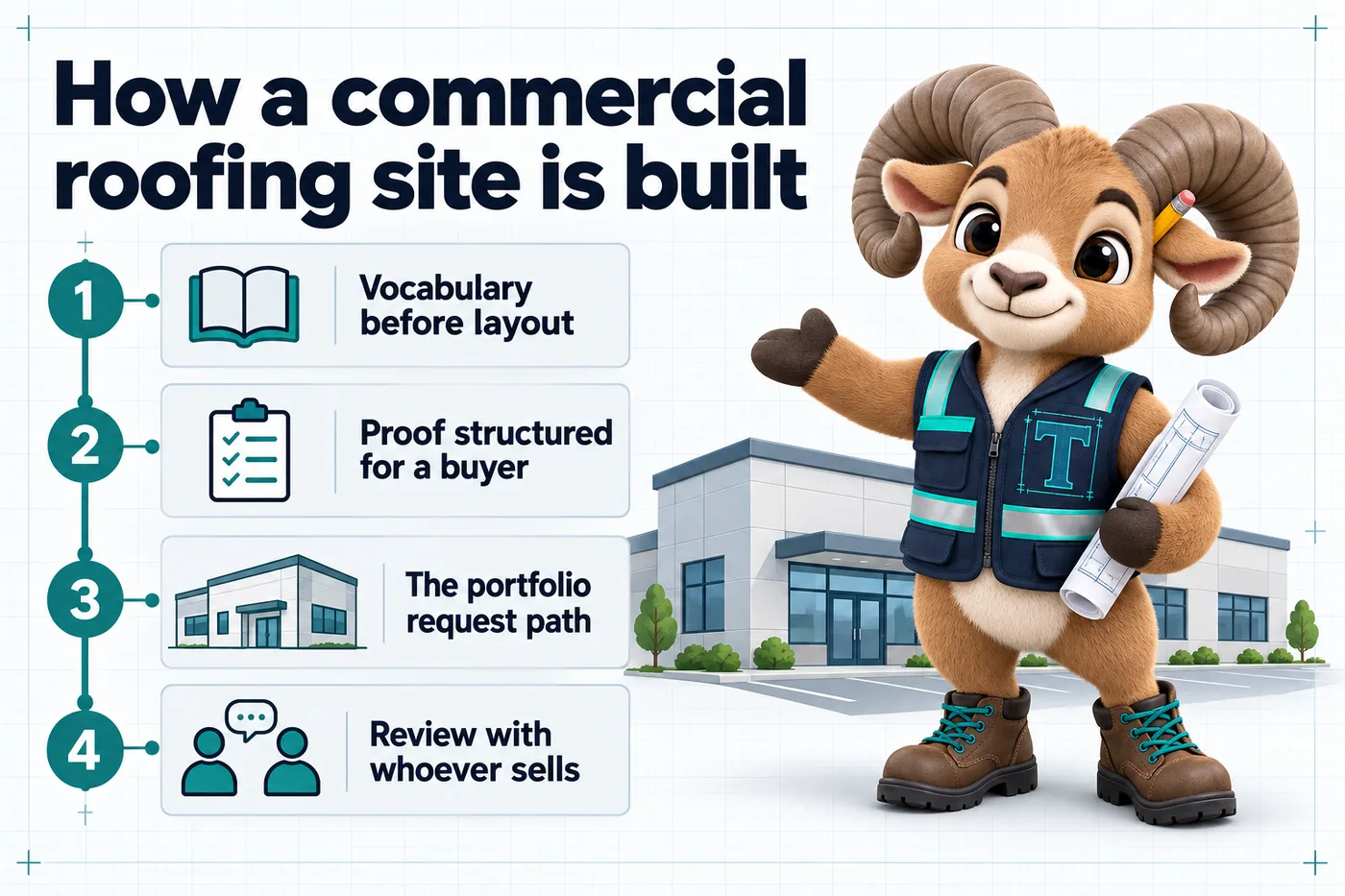
A residential homeowner responds to a photo gallery. A commercial buyer wants case studies with specifics: square footage, system type, timeline. We build a dedicated case study format so past commercial work reads as proof of capability rather than a decorative photo grid.
A property manager overseeing several buildings needs a way to describe a multi-building request in one submission, not a residential-style single-address form. We build that into the quote tool as part of the design, not a separate form buried on another page.
The second list matters more than the first. A scope with no exclusions is a scope nobody has thought about.
Included
Not included
If you need one of these, say so on the demo. We would rather point you somewhere else than take the work and disappoint you.
We start from the terms your buyers search: system names, contract types, building categories. The page plan follows that language rather than a residential template.
We build the case study format first and populate it from projects you supply, so past work reads as evidence of capability rather than as decoration.
The quote tool is configured for multi-building requests before launch, and tested with a submission that looks like a real portfolio enquiry.
Your estimator or sales lead reviews the system pages, because they are the person who will be asked about anything on them.
How long it takes
Same build window as any plan. The one thing that moves it is how quickly your team can supply real project details for the case studies.
None of these change the plan price. They change how much work sits inside it, which is why the fee is a plan rather than an hourly rate. See the plans.
Dedicated pages for TPO, EPDM and modified bitumen, each written to rank on its own.
A repeatable page structure for documenting past commercial projects.
Explains recurring inspection and maintenance work, a common commercial entry point.
Captures a portfolio request in one submission rather than several.
Nothing on this page is an add-on or an upsell. The three plans differ in launch time, article volume and whether the AI Engine and Content Engine are included.
| Draft | Elevation | Structural | |
|---|---|---|---|
| Everything on this page | Included | Included | Included |
| Live in | 7 days | 10 days | 15 days |
| Researched articles a week | 2 | 2 | 3 |
| AI receptionist, chat and SMS | Not on this plan | Included | Included |
| Content Engine and Google Business Profile | Not on this plan | Not on this plan | Included |
From roofing companies we have built for
Emma Stanton
Customer care coordinator, leisure center roofing contractor
The part I rate most highly is the form, not the visuals. Every submission arrives with building use, roof type and site location filled in, which used to take us a second email to obtain. The first message is usually enough to act on now.
Inquiry form and response workflow for commercial roof assessments
Ashleigh Sanderson
Scheduling supervisor, single-ply membrane roofing installer
I tested the commercial roof assessments page on my own phone before we approved anything. Key information comes first and the contact option is clearly labeled. The days of talking customers through the menu are over.
Mobile navigation and page layout for commercial roof assessments
Warren Harrington
Site survey coordinator, gutter and rainwater systems contractor
The starting point was our own sent mail, not a template, and it shows. Each answer was reviewed by our own staff, so the page sounds like us rather than a copywriter. Pointing people to the page has replaced hunting through old emails.
FAQ research and editorial review for commercial roof assessments
Each of these is a full comparison with the case for the other option written first. Some of them will tell you not to buy from us.
Yes, if that is how your business is actually structured, but each side gets its own section and vocabulary rather than being mixed on the same pages, so neither audience feels like an afterthought.
Yes, on plans with a weekly article allowance. You send the project details and photos and our editorial lead writes it up, citing nothing that was not confirmed by you.
Usually yes, with a clear split from the first screen, because the two audiences search completely differently. Where a company is genuinely two businesses with separate sales teams and brands, we will say so and discuss separate sites rather than forcing a merge.
Building type, roof system, approximate area, timeline, what the problem was and how it was solved. A facilities manager is assessing capability, not admiring photography, and those five details do more than twenty images.
Yes. The quote tool asks for building count and lets the requester describe a portfolio need in one submission, rather than making them fill out a residential-style form once per address.
Only ones you confirm you hold, named exactly as the manufacturer names them. We will not publish a certification claim on your behalf without confirmation, because in commercial roofing that is the claim most likely to be checked.
Yes, as a capability page a facilities manager can forward internally. We publish what you supply, described factually, with the actual documents behind a request rather than posted publicly.
With a capability page that states what you carry in plain text and puts the actual certificates behind a request. A facilities manager needs to see that the cover exists before they call; they do not need the PDF posted publicly.
A live walk-through of the site you would get, in about 30 minutes. Plans from $127 a month, the $697 build fee invoiced only after launch, domain and hosting included.
Book a demoOr email and a person replies within one working day.
RoofingWebStudio uses the cookies below. Necessary cookies keep the site working and cannot be turned off.
Saved on this device only. Press Esc to close.